
Surprisingly Little Stabbing
Is D&D a combat game?
People have argued about this for as long as the game has existed, usually armed with a rulebook (mostly combat rules) and a character sheet (mostly combat stats). In 2000, Wizards of the Coast put actual numbers behind the argument in its landmark market survey: 86% said they played "combat oriented" games. That number counts what people have played, ever, yes-or-no. It was the only kind of question a survey could ask. A survey can't sit at the table.
Twenty-six years later, we looked at anonymized data from a set of ten thousand sessions to see if we could answer the question the survey couldn't: where do the night's hours actually go?
About a fifth of them go to combat. And 28% of sessions never roll initiative at all.
This is the first post in a series on what tables actually do. Some of it we think will genuinely help people run better nights; some of it we don't fully understand the implications of yet. That's fine. This community argued its way from THAC0 to advantage. It's full of people smarter than us, and we'd rather hand them real numbers and get out of the way.
An Evening, Itemized
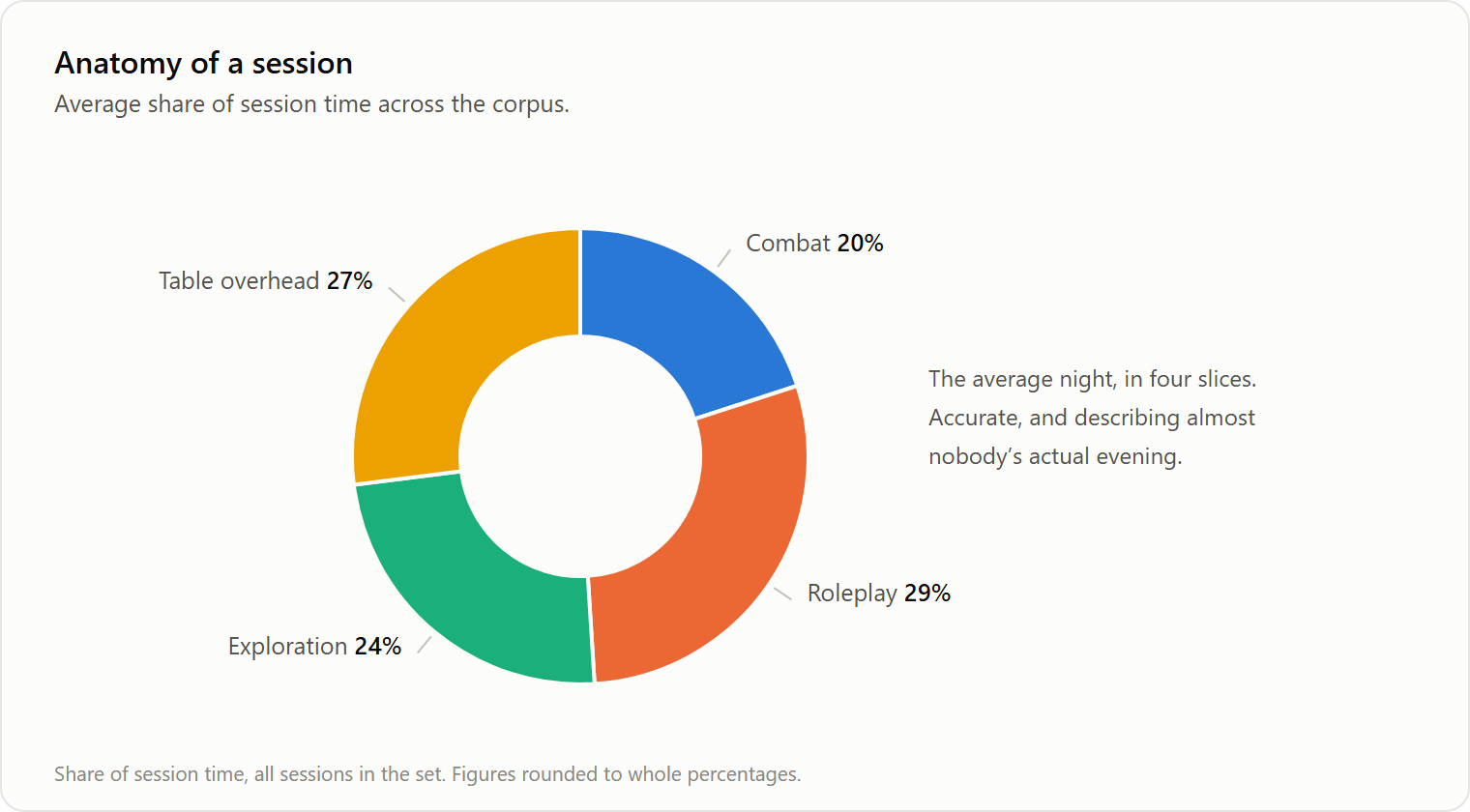
Every data project produces a pie chart whether you want one or not, so let's get ours out of the way. Averaged across every session in the set, the night splits like this: 20% combat, 29% roleplay, 24% exploration, and 27% overhead. Overhead is everything out of character, like rules lookups, scheduling, "wait, where were we" (we'll come back to this later, because it turned out to be one of the most interesting slices).
28% of sessions contain no combat at all. More than a third stay under 5%. And the session that matches the game's public image, the battle map and the miniatures and somebody's carefully tracked initiative order, the night that is mostly fighting? That's 8.7% of everything we measured. Fewer than one night in eleven.
You might guess this splits neatly by group: fighty tables and talky tables, each consistent in its own way. Not really. Pick two sessions from the same campaign at random and their combat shares differ by 18 points, on average. The group that fought for two hours last week is scheming in a tavern this week.
That swing is the norm, not a quirk. Among campaigns at least five sessions in, about three-quarters (77%) have already had both kinds of night: one under 5% combat and one over 30%. Campaigns resemble each other much more than the fighty-table-versus-talky-table framing suggests. The quiet night and the battle night live in the same campaign, just in different weeks.
The evenly blended session, a bit of everything in tidy proportions, does exist: 5.8% of the time. Campaigns that produce that blend reliably? Of all the campaigns in the data set, we could count them on one hand.
So there is no typical mix. There is, however, a typical clock, and it turns out to be nearly the same clock everywhere.
Roll for Initiative (Eventually)
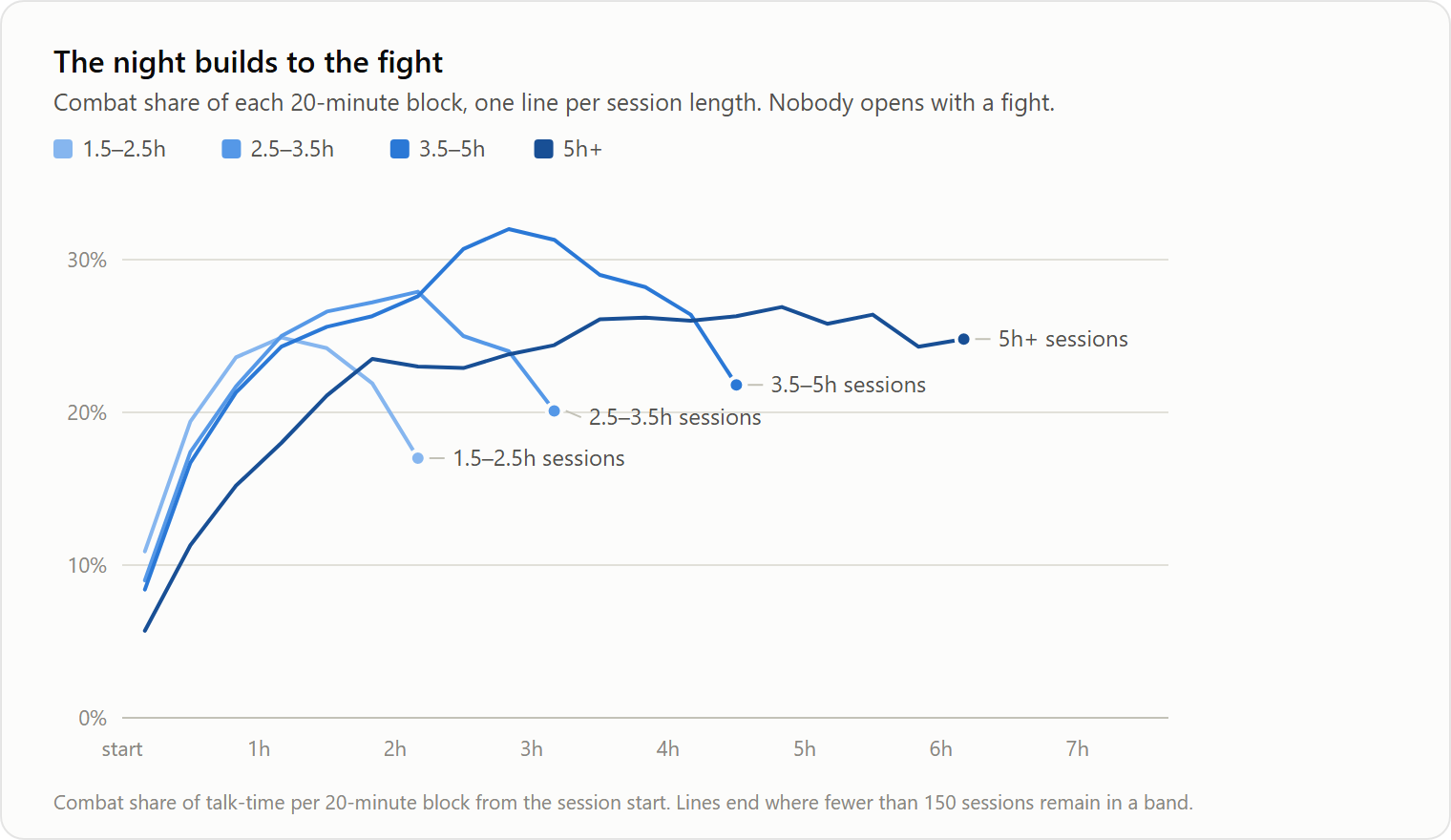
The first twenty minutes of a session are 10% combat and 35% overhead (surprising no one). Someone's mic doesn't work. Nobody remembers what happened last session, which was one week ago (the DM, who has thought about it every day since, recaps with dignity). Then the session starts, gently. The longer the night is going to run, the more gently it starts, with five-hour plus sessions open at 6% combat.
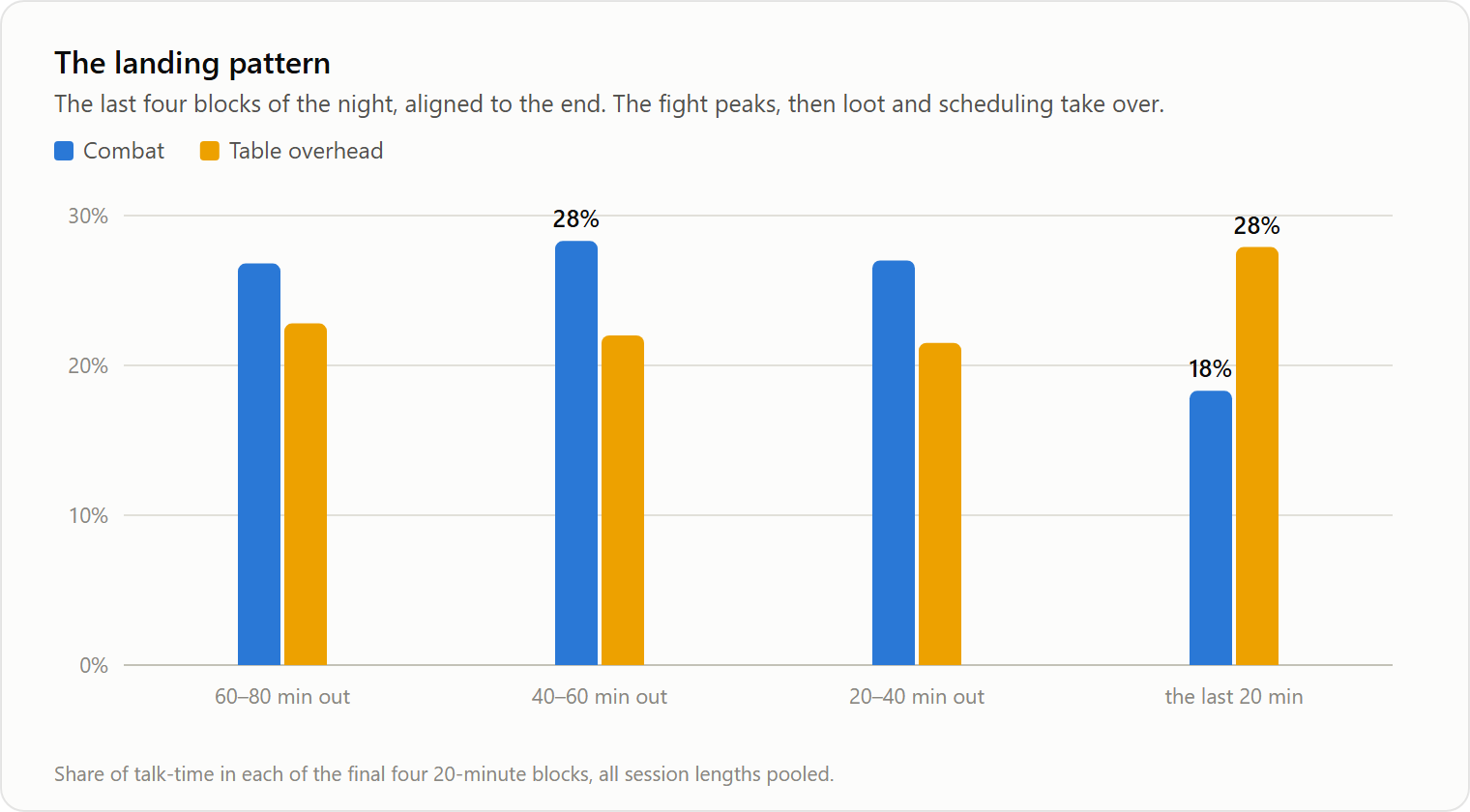
From there, combat climbs. Steadily, all night. It peaks 20 to 60 minutes before the end, at about 28%, and then the last stretch winds down: combat falls back to 18% while overhead rises again, as loot gets divided and the party takes on the night's hardest challenge, which is finding a date everyone can make for the next session.
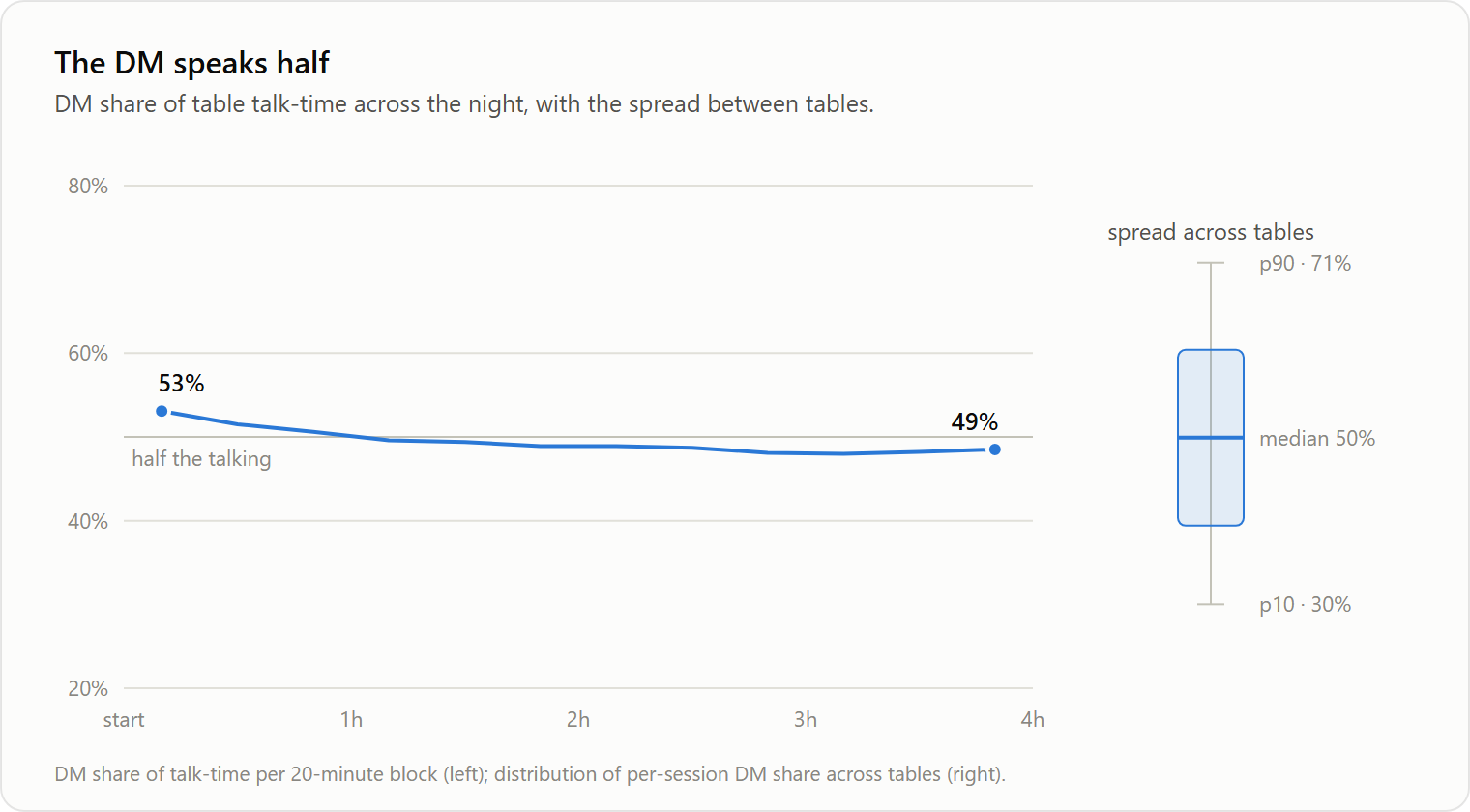
While all of this is happening, the DM is talking. Half the time, literally: the median DM speaks 50% of the night's talk-time, and that share barely moves across the evening, 53% in the opening minutes, 48% by the fourth hour. Between tables it moves plenty. The middle half of tables sits between 39% and 60%, and the tails stretch from 30% to 71%.
And everyone slowly runs out of words. Talk drifts from 119 words a minute in the first hour to 110 past the five-hour mark, a gentle fade that happens even while the combat share is still climbing. Fewer words, more dice.
Which leaves the overhead (remember, 27% of the evening). It splits in a way we didn't expect. Rules talk (lookups, questions, the occasional dispute) is 37% of it. Off-topic banter is 33%. Logistics takes 15%, recaps 13%. Spread that over the whole night and you get two nearly identical taxes: about one hour in ten goes to the rulebook, and almost exactly as much goes to talking about anything except the game. We assumed rules would dwarf banter but they're nearly tied (and honestly, a tenth of the night spent on your friends' actual lives might be the healthiest number in this post).
Your Table Has a Shape
Trace each session's combat arc across the night and five recurring shapes cover more than nine in ten sessions.
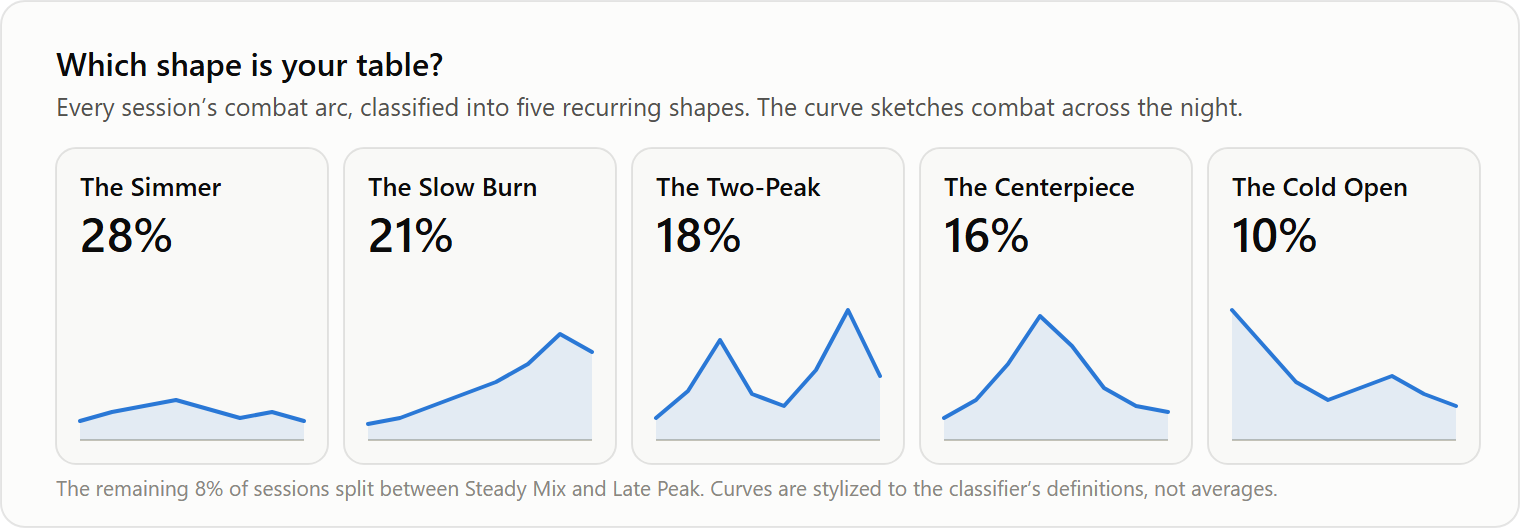
The Simmer (28%). Combat never really arrives. The night is talk, plans, and a single persuasion check that becomes forty minutes of scheming. The single most common session in the data is one where nobody swings a sword.
The Slow Burn (21%). Story for most of the night, then a fight late, once everything has been set up to mean something.
The Two-Peak (18%). A fight in the middle, a breather, a bigger fight near the end. The adventuring day as the books imagine it, and the signature shape of the marathon session.
The Centerpiece (16%). One big set-piece in the middle of the night, and a long wind-down after it.
The Cold Open (10%). The night that starts hot, the ambush already rolling. Rarer than you'd think.
(The remaining sliver splits between the Steady Mix, the even blend from earlier, and the Late Peak, which is a Slow Burn that waited even longer.)
The shape follows the runtime. Sessions in the two-hour range are the Simmer 39% of the time; five-hour-plus sessions are Two-Peaks 41% of the time. Short nights and long nights reliably take different shapes.
So: which one is your table? Probably several of them. That 18-point swing means that if you logged your last six sessions honestly, you'd likely find three shapes in the mix. What the shapes do to the people at the table (who has a great night in which kind of session) is something we may try to dig into later in this series.
Half the Fight Is Paperwork
One more number.
Inside combat itself, the 20% of the night this whole argument is about, just over half the time (55%) is administration. Turn order. Rules lookups. Character-sheet math. "Does that provoke an opportunity attack?" Measured honestly, the fight is half spreadsheet.
The system differences point the way you'd guess. Pathfinder tables pay the steepest rules tax of the big systems: roughly two-fifths of their overhead is rules talk, against about a third for D&D. Daggerheart, which promises fast, flowing combat, does measurably deliver the lightest fights of the three, running about seven points less admin than D&D's. And bless our friends still playing AD&D, where the fight is closer to two-thirds admin.
Which brings us back to 2000 one last time. Buried in that same survey: 52% of players said they wanted to buy software "to help manage game and speed up combat." The report went further, predicting that paper RPGs would "hybridize with computer assistance," not becoming videogames, just no longer played with paper alone. They were right. Digital character sheets, D&D Beyond, virtual tabletops, dice rollers: the hybridization arrived years ago, mostly without anyone calling it that.
So our last number should sting a little. Players asked for software to speed up combat. It arrived, an entire ecosystem of it. And the fight is still half paperwork.
The numbers here come from roughly ten thousand US tabletop sessions (mostly, but not only, D&D) recorded through SessionKeeper and analyzed as anonymized data points. No human read a transcript; models did the reading, and, as with everything in SessionKeeper, no model trains on campaign data, in the app or in this analysis. The reading is stateless: the models count, report a number, and retain nothing. Every published figure aggregates at least 25 distinct groups; anything smaller stays unpublished.
The bias worth naming plainly: tables that record their sessions are probably more organized and more committed than the hobby at large. We think that makes the low numbers stronger, not weaker. A sample tilted toward serious tables still spends only a fifth of the night in combat.
Time was measured in twenty-minute intervals. And every campaign has a "Community Insights" toggle in its settings: switch it off and your table is automatically excluded from every number in this series.